Why Your Credit Card Debt Isn’t Going Down (And How to Fix It)
October 15, 2026 • 8 min read
Making credit card payments but your balance barely moves? Learn how interest, minimum payments, and spending affect your debt—and how to pay it off faster.
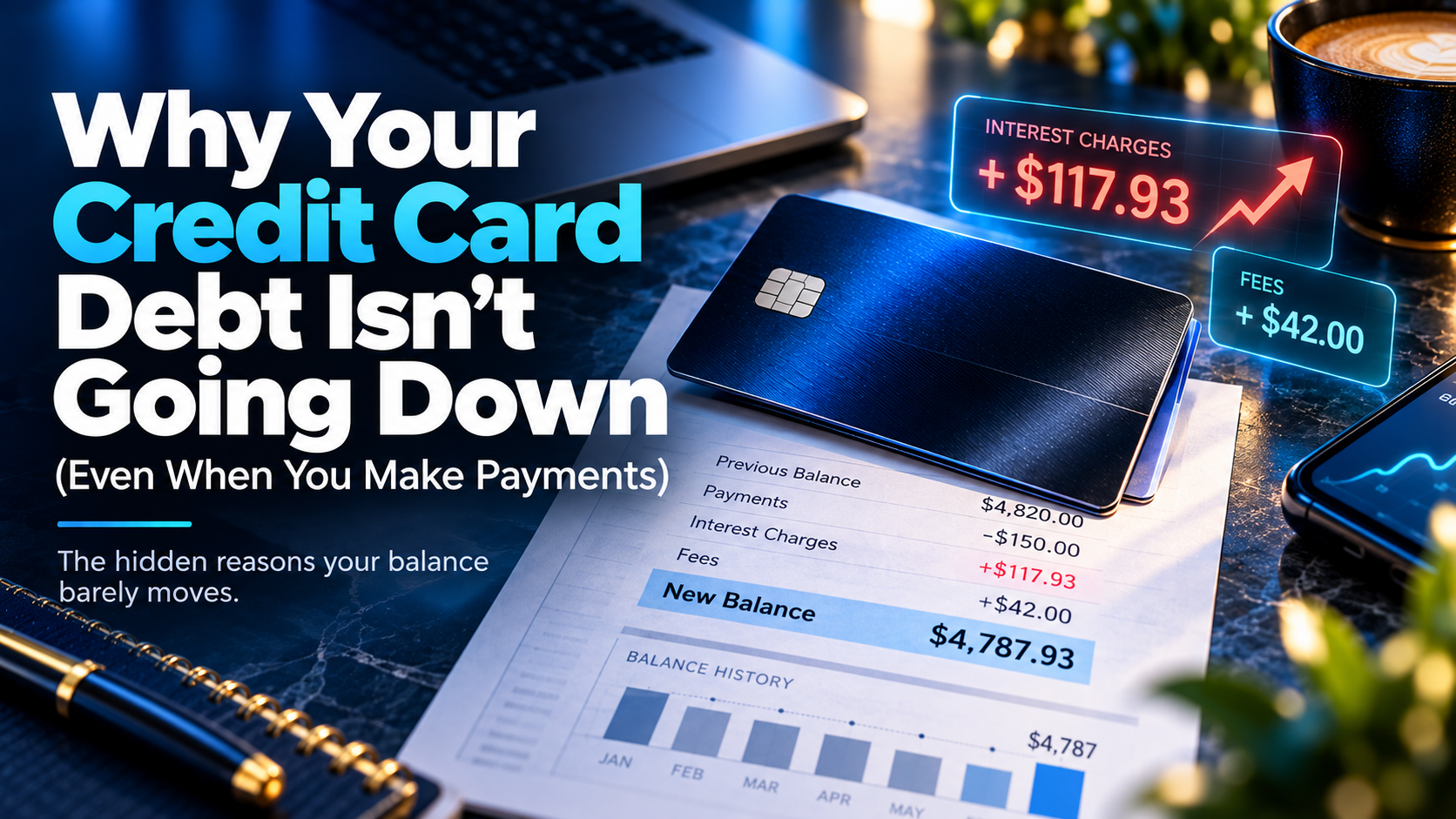
Are you making credit card payments every month, avoiding missed due dates, and still seeing almost no progress on your balance? You are not alone. Interest charges, minimum payments, and new purchases can make credit card debt difficult to eliminate. Understanding where your money goes can help you build a more effective payoff plan.
Your Credit Card Interest Is Consuming Your Payments
Your annual percentage rate (APR) determines how expensive it is to carry a credit card balance. Interest is commonly calculated using your daily balance and a periodic rate, so the amount charged depends on your card's terms, billing cycle, transactions, and payment timing.
For example, a $5,000 balance at 24% APR could accrue roughly $100 in interest over a simplified month. If you pay $150, only about $50 would reduce the principal under that simplified example. Actual interest charges may differ.
Minimum Payments Can Keep You in Debt for Years
Paying the minimum can keep your account current, but it may do little to reduce the balance quickly. When a large part of your payment goes toward interest, repayment can take years. Minimum payments may also decline as your balance falls, slowing your progress if you continue paying only the required amount.
An Extra $50 or $100 Per Month Can Make a Huge Difference
Consider a $5,000 balance at 24% APR, with no new purchases and a fixed monthly payment. These simplified estimates assume interest of 2% per month and payments continuing until the balance is paid off.
- $125 per month: approximately 6 years and 10 months, with $5,159 in interest.
- $150 per month: approximately 4 years and 8 months, with $3,322 in interest.
- $200 per month: approximately 3 years, with $2,001 in interest.
- $250 per month: approximately 2 years and 2 months, with $1,449 in interest.
These figures are illustrative, not a payoff quote. Your card's actual APR, interest calculation, fees, and payment dates can change the result. Try different payment amounts with our Credit Card Payoff Calculator.
https://www.findmymonthlypayments.com/credit-card-payoff
You're Continuing to Use the Credit Card While Paying It Off
If you pay $200 but add $150 in new purchases, your balance falls by only $50 before interest and fees. New purchases may also accrue interest immediately if you have lost your grace period. Where possible, avoid adding new charges while paying down the existing balance.
Your Interest Rate Might Be Higher Than You Realize
Check the APR shown on your statement or account. A higher rate can make the same balance much more expensive to repay. You can ask your issuer whether a lower rate is available, although approval is not guaranteed. If considering a balance transfer, compare transfer fees, promotional periods, and the rate that applies after the offer ends.
You Don't Have a Specific Debt Payoff Goal
A clear target makes it easier to decide how much to pay each month. For example, someone with a $5,000 balance might aim to clear it within three years. At a 24% APR, a payment of roughly $200 per month may be a useful starting estimate under simplified assumptions. Use a calculator to refine your own target.
You're Not Using the Right Debt Repayment Strategy
Two common approaches can help you organize payments:
- Debt avalanche: pay the minimum on each account and direct extra money toward the debt with the highest interest rate. This generally minimizes interest when other factors are equal.
- Debt snowball: pay the minimum on each account and direct extra money toward the smallest balance. Clearing accounts sooner can help some people stay motivated, though it may cost more in interest.
Choose a method that fits your budget and that you can follow consistently.
How to Finally Start Making Progress
- List each credit card's balance, APR, and minimum payment.
- Review your budget and choose an extra payment you can afford without neglecting essential bills or your emergency savings.
- Limit new purchases on the cards you are paying off.
- Choose a repayment strategy and track your balance each month.
- When one debt is cleared, redirect the money you were paying toward the next debt or another financial goal.
Even a manageable increase can help. For example, raising a payment from $150 to $200 on a $5,000 balance at 24% APR could substantially reduce payoff time and interest under the assumptions above. Your actual savings will depend on your account terms and payment habits.
The Bottom Line
When your credit card balance barely changes, interest, minimum payments, and continued spending may be working against you. If your budget allows, increase your payment, avoid adding new charges, and follow a realistic payoff plan. Small, consistent steps can make your debt easier to manage.
Use our free Credit Card Payoff Calculator to compare payment amounts and estimate your payoff timeline: https://www.findmymonthlypayments.com/credit-card-payoff
Frequently Asked Questions
Why is my credit card balance barely decreasing?
Interest and fees may consume much of your payment. New purchases can also offset the amount you pay. Review your statement to see how each payment is being applied.
Is it better to pay more than the minimum?
Generally, yes, if you can afford it while meeting essential expenses. Paying more toward the balance usually reduces interest costs and repayment time.
How much extra should I pay?
There is no single amount that works for everyone. Even an extra $25 or $50 per month may help. Use your budget and a payoff calculator to find a sustainable amount.
Does paying off credit card debt improve my credit score?
Reducing credit card balances can improve your credit utilization and may help your score. The effect depends on your overall credit profile and other scoring factors.
Should I pay off credit cards or save money first?
Your situation matters. Keeping some emergency savings can help prevent unexpected expenses from becoming new debt, while paying down high-interest balances can reduce interest costs. Consider your essential expenses, debt rates, and available cash.
This article is for general educational purposes only and is not personalized financial advice. For additional consumer information, visit the Consumer Financial Protection Bureau at https://www.consumerfinance.gov/consumer-tools/credit-cards/ or the Federal Trade Commission at https://consumer.ftc.gov/.